Eras
Retro jewelry guide, 1935 to 1950
Rose gold, sculpted volume and big colored stones, born out of wartime scarcity.
Written by our in-house jewelry team · Updated August 1, 2026 · 6 min read
In short
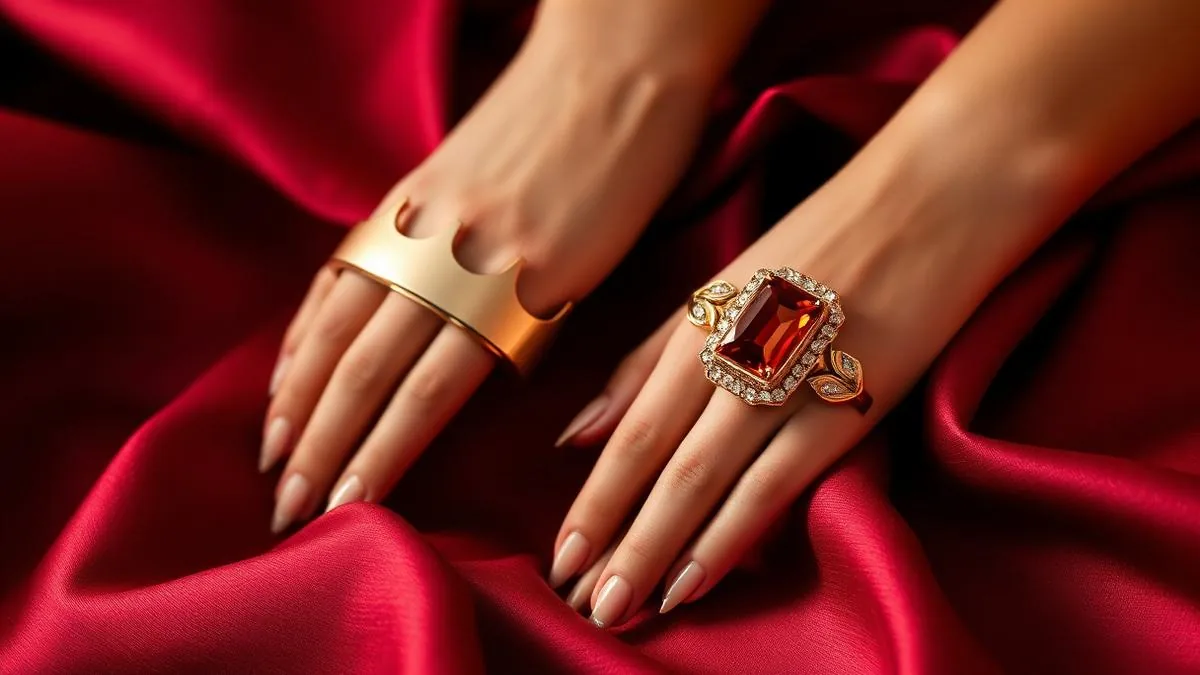
Retro jewelry runs roughly from 1935 to 1950. Platinum was restricted for war production, so jewelers worked in yellow, rose and green gold, built big sculptural forms out of relatively little metal, and set them with large, affordable stones such as aquamarine, citrine and openly synthetic ruby and sapphire.
Retro is the most physical of the twentieth century styles. Where Art Deco is flat and graphic, Retro is curved, folded and three dimensional, closer to sculpture than to drawing.
It is also the era where scarcity shaped the look. Platinum went to the war effort, gold supply was tight, and jewelers responded with hollow construction, tubular gaspipe links and gold alloyed pink or green to stretch what they had.
Shop the pieces: Retro, curated and available now.
What to look for
Rose gold is the single strongest signal, usually 14K or 18K with a high copper content. Green gold appears alongside it in leaf and ribbon motifs, giving a two-tone effect within one piece.
Forms are architectural but soft: scrolls, bows, ribbons, fans, snake and gaspipe chains, wide tank bracelets, and rings with stepped, buckled shoulders.
- Large step-cut or emerald-cut aquamarine, citrine, and amethyst centers
- Small round or calibre-cut rubies and sapphires used as color accents, often synthetic and openly so at the time
- Hollow or tubular construction that feels lighter than it looks
- Clip brooches with double-pronged clip fittings rather than a simple pin
Synthetic stones are not a fault here
Flame-fusion synthetic rubies and sapphires had been commercially available since the early 1900s and were used deliberately in fine Retro jewelry, including by major houses, for consistent color in calibre-cut rows.
A synthetic accent stone in a Retro piece is period-correct rather than a sign of a fake. What matters is disclosure: our gemologist, a GIA Graduate Gemologist (GG), identifies natural and synthetic before a piece is listed, and the description says which.
“Retro is the one period where a synthetic stone is not a warning sign. It is period-correct, and it should be disclosed in writing all the same.”
Condition and wearability
Hollow gold dents rather than breaks. Check the underside of wide bracelets and the backs of clip brooches, where a lifetime of pressure shows first.
Retro rings are usually generous in metal at the shank, which makes them among the easier antique rings to resize. Large step-cut stones are more prone to chipped corners, so examine the girdle edges under magnification.
Buying notes for US buyers
Retro is one of the few periods where the American and the European version of the same style look genuinely different. American work of the 1940s is most often 14K and tends toward wide, confident bracelets and cocktail rings. French pieces of the same years are usually 18K, carry French marks, and are often lighter in the hand than their scale suggests.
Because so much Retro is hollow, weight is a poor guide to value. Judge it on the quality of the goldwork, the condition of the hollow sections, and the stones, and treat the marks as the fastest way to tell where a piece was made.
Frequently asked questions
- Is Retro jewelry considered antique?
- No. Antique generally means at least 100 years old, so Retro pieces from 1935 to 1950 are vintage rather than antique.
- Why is so much Retro jewelry rose gold?
- Copper was more available than the other alloying metals during and after the war, and platinum was reserved for military use. Adding copper turns gold pink.
- Is Retro gold usually 14K or 18K?
- American Retro is most often 14K, while French and other continental European work is typically 18K, marked 750 or with an eagle's head.
Written by our estate jewelry team and reviewed by our in-house gemologist, a GIA Graduate Gemologist (GG). We have been buying and selling European antique jewelry since 1973.
From the reading to the piece
Shop Retro jewelry
Each piece is one of a kind and sells once, so this collection changes constantly.
View retroRelated guides
Keep reading
eras
Mid-century jewelry guide, 1950 to 1970
Textured gold, clean solitaires and the first modern brilliants.
eras
Art Deco jewelry: a complete guide
1920 to 1935, when jewelry stopped imitating flowers and started imitating architecture.
gemstones
Aquamarine, and the case for a big stone
Emerald's clean-living cousin: big, bright and surprisingly affordable.