How-to & tools
How to measure your ring size
Four ways to find your size at home, the traps that make people order a size wrong, and a converter between US, EU and UK sizes.
Written by our in-house jewelry team · Updated June 12, 2026 · 9 min read
In short
Measure an existing ring that fits the right finger by its inside diameter in millimeters, or wrap a strip of paper around the finger and measure the length in millimeters to get the circumference. Measure at the end of the day when fingers are largest, take it two or three times, and size up if a knuckle is wide. Antique rings cannot always be resized, so tell us the finger and the size before you buy.
Almost every ring we sell is European, and almost every customer who buys one is American. That means two numbers: the European size stamped or measured on the ring, which is simply the inner circumference in millimeters, and the US size you are used to. A European 54 is a US 7.
This guide shows you how to find your size at home, how to convert it, and how to avoid the three mistakes that account for nearly every resize request we receive. If you would rather have us do it, book a video viewing and one of our jewelers will talk you through it while you measure.
Shop the pieces: Solitaire, curated and available now.
Ring size converter
Convert a size you already know
Enter a size in the system you know and we will show you the same ring in the other three.
- US
- 7
- EU
- 54.5
- UK
- O
- Diameter
- 17.3 mm
Inner circumference 54.5 mm, inner diameter 0.68". Sizes fall between systems, so we round to the nearest half size the way a jeweler would.
One page, US and EU scales. Print at 100 percent, no page scaling, then check the ruler line before you cut.
Method 1: measure a ring you already own (most accurate)
This is the method we trust most, because it measures a ring rather than a finger. Take a ring that fits the intended finger comfortably, and measure the inside diameter, edge to edge across the widest point, with a ruler that has millimeters.
Read the number to the nearest half millimeter. A 16.9 mm inner diameter is a US 6.5, or a European 53. Put that number into the converter above and you have all three systems at once.
- Measure the inside, not the outside, of the band
- Use millimeters; a US size changes roughly every 0.4 mm, so inches are too coarse
- If the ring is not perfectly round, measure twice at right angles and average
Method 2: the paper or string strip
Cut a strip of paper about 4 mm wide, wrap it snugly around the base of the finger, mark where it overlaps and lay it flat against a ruler. The length in millimeters is your European size directly, because the European system is the circumference.
Paper is better than string, which stretches. Wrap it firmly enough that it cannot slide off but loosely enough that it does not dent the skin. Then check it can pass over the knuckle before you trust it.
Method 3: our printable ring sizer
Print the sizer below at exactly 100 percent, with page scaling switched off, and verify the calibration ruler on the sheet with a real ruler before you cut anything. A single percent of print scaling is roughly half a size.
Cut out the strip, slide it around your finger and read the size at the arrow. Do it twice, at two different times of day.
Method 4: ask a local jeweler
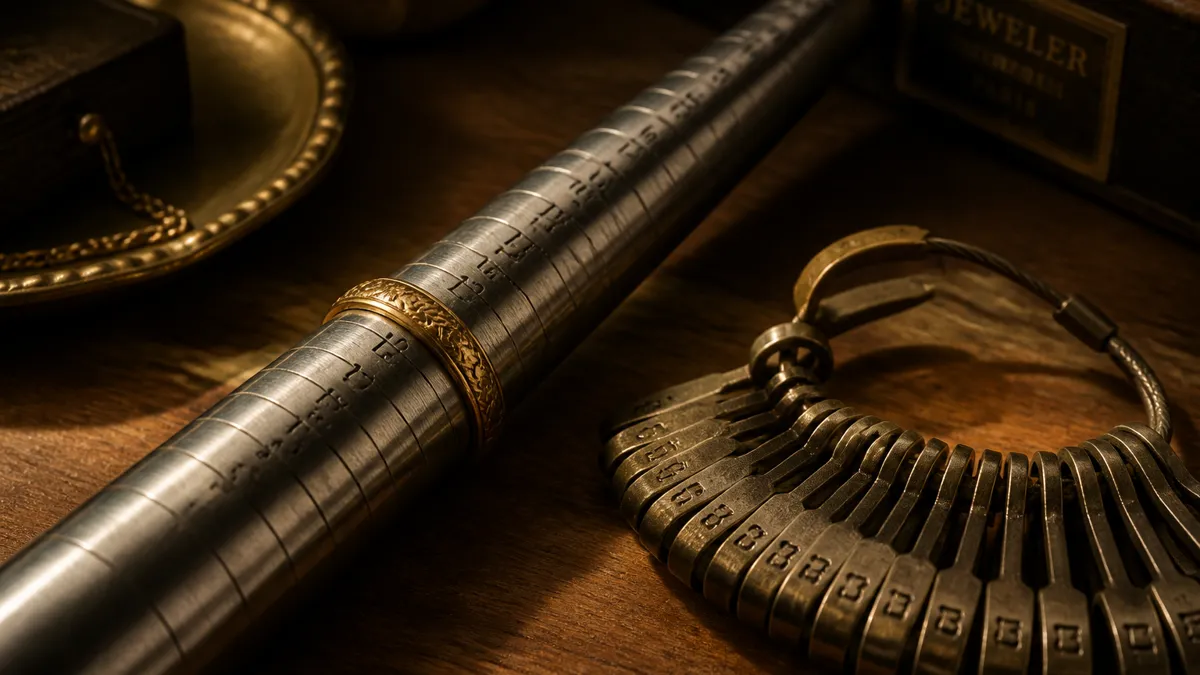
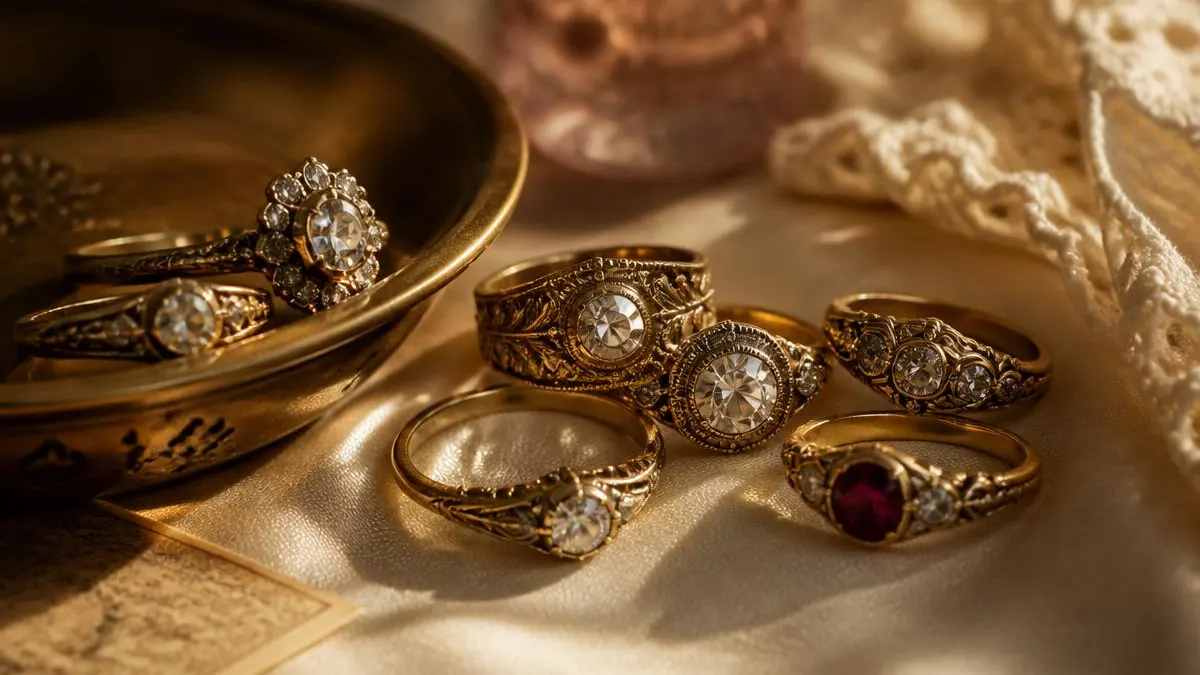
Any jeweler will size your finger with a set of steel rings in a minute, usually for free. Steel sizers are the standard the whole trade works from, so if you are buying an expensive antique ring, this is worth the walk.
Ask for the size in millimeters as well as the US number. Millimeters travel between systems without rounding.
The three mistakes that cause almost every resize
Temperature comes first. Fingers can change close to a full size between a cold morning and a warm evening, and they swell after exercise, salt, alcohol and long flights. Measure at the end of a normal day, at normal room temperature, and measure at least twice.
Band width comes second. A wide band takes up more of the finger and feels tighter, so a 6 mm Art Deco band usually needs a quarter to a half size more than a 2 mm one. Old rings are often wider than they look in a photograph.
Knuckles come third. If your knuckle is noticeably larger than the base of your finger, size so the ring passes the knuckle with a little effort, then accept that it will be slightly loose at the base. A ring that fits the base but not the knuckle simply cannot be worn.
- Measure warm, at the end of the day, and never right after exercise
- Add a quarter to a half size for bands wider than about 5 mm
- Size to the knuckle, then use sizing beads to steady the fit
- Right hands are often a quarter to a half size larger than left
Reading European sizes on our pieces
On every ring in our collection we publish the size in both systems, so you never have to convert anything yourself. The European number is the inner circumference in millimeters, exactly as it is measured in our workshop in the Netherlands.
Because the two systems do not line up perfectly, some European sizes fall between US half sizes. Where that happens we show the nearest US size and mark it as approximate, which is how a jeweler would describe it too.
Can an antique ring be resized?
Often, but not always, and it is a decision worth making before you buy. A plain gold shank can usually move one to two sizes in either direction safely. An eternity band set all the way around, a shank with original hand engraving, or a ring with a hallmark on the band frequently cannot be cut without destroying part of what makes it valuable.
Where resizing is not advisable we say so on the product page. Sizing beads, a spring insert or a discreet inner sleeve keep the ring original and still make it wearable. Ask us on a video call and we will tell you honestly what a specific ring can take.
Frequently asked questions
- What is my US ring size if I know my European size?
- European sizes are the inner circumference in millimeters. A European 52 is about a US 6, a 54 is about a US 7 and a 57 is about a US 8. Use the converter on this page for the exact match, including UK letters.
- What time of day should I measure my ring size?
- At the end of a normal day, at room temperature. Fingers are smallest when cold in the morning and largest after heat, salt, alcohol or exercise, and the difference can be close to a full size.
- Should I size up for a wide band?
- Yes. A wide band sits against more of the finger and feels tighter. For bands over about 5 mm, go a quarter to a half size larger than your measured size.
- How do I measure a ring size for a surprise gift?
- Borrow a ring she already wears on the right finger and measure its inner diameter in millimeters, or press it into a bar of soap and measure the impression. If you are unsure, book a video viewing and we will help you choose a piece that is straightforward to resize.
- Can you resize an antique ring?
- Usually by one or two sizes, but not always. Eternity bands, engraved shanks and rings with a hallmark on the band often cannot be cut without losing value. We tell you on the product page and on a video call what a particular ring can safely take.
- How accurate is a printable ring sizer?
- Accurate to about a quarter size if you print at exactly 100 percent with page scaling turned off and check the calibration ruler first. Measuring an existing ring in millimeters is more reliable.
Written by our estate jewelry team and reviewed by our in-house gemologist, a GIA Graduate Gemologist (GG). We have been buying and selling European antique jewelry since 1973.
From the reading to the piece
Shop vintage rings
Each piece is one of a kind and sells once, so this collection changes constantly.
View solitaireRelated guides
Keep reading
how-to
Ring size chart (US, EU and UK)
A full conversion table between US numbers, European circumference sizes, UK letters and inner diameter.
buying
The vintage engagement ring buying guide
Everything we would want a friend to know before spending several thousand dollars on a ring made a century ago.
authenticity
How to care for your vintage jewelry
Why repolishing can halve the value of a piece that took a century to earn its surface.