Eras
Art Deco jewelry: a complete guide
1920 to 1935, when jewelry stopped imitating flowers and started imitating architecture.
Written by our in-house jewelry team · Updated July 28, 2026 · 9 min read
In short
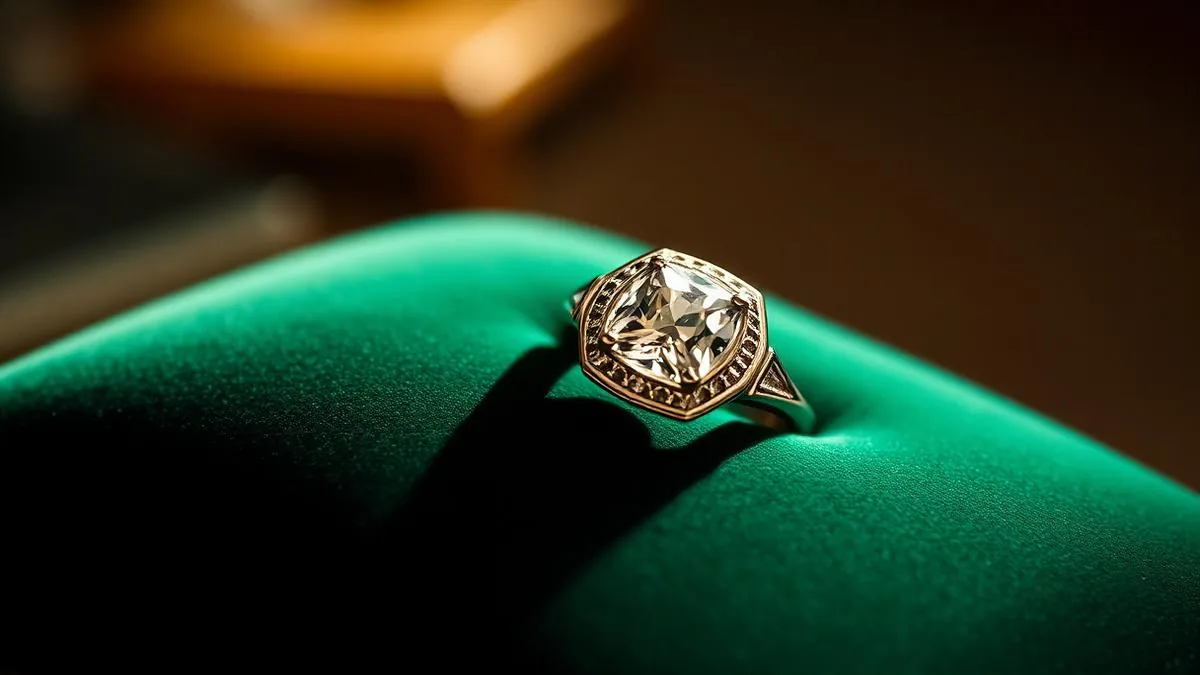
Art Deco jewelry was made roughly between 1920 and 1935. It is recognized by strict geometry and symmetry, calibre-cut colored stones set flush against diamonds, platinum or white gold mounts, and old European, transitional and baguette cuts. Contrast is the period's signature: white diamonds against onyx, sapphire, emerald or coral.
Art Deco is the most recognized and the most copied of all jewelry styles. Between roughly 1920 and 1935, jewelers threw out the soft garlands of the Edwardian years and replaced them with straight lines, hard contrast and stones cut to fit a drawing rather than the other way around.
That is also why so much of what is sold as Art Deco is not. This guide is what we tell our own customers when they hold a piece up to the light: what the period really looks like, how to date it, and where reproductions give themselves away.
Shop the pieces: Art Deco, curated and available now.
What Art Deco actually means
The name comes from the 1925 Exposition Internationale des Arts Décoratifs et Industriels Modernes in Paris. The style was already moving before that fair and carried on well after it, so treat 1920 to 1935 as the core and allow a few years on either side.
The idea behind it was machine-age confidence. Jewelers were designing for women who drove cars, cut their hair short and wore long straight dresses that needed long straight jewelry. Symmetry, repetition and a strong outline mattered more than sentiment.
- Geometry first: rectangles, stepped shapes, chevrons, targets and tight repeats
- Hard color contrast: onyx against diamond, sapphire against platinum, coral against jade
- Calibre-cut stones, shaped to fill a channel exactly with no gaps
- Platinum or white gold, often with knife-edge or millegrain detail
- Egyptian, Persian and East Asian motifs after the Tutankhamun discovery in 1922
How to date an Art Deco piece
Start with the metal. Platinum dominates the 1920s. In the United States and much of Europe platinum was restricted during the Second World War, so a platinum mount with Deco geometry almost always predates 1940. White gold appears alongside it from the mid-1920s, particularly on more affordable pieces.
Then look at the stones. Old European cut and transitional cut diamonds belong to the period: next to a modern round brilliant they have a smaller table, a higher crown, a shorter, chunkier pattern of facets and usually an open culet you can see straight down through the stone. A modern round brilliant, with its wide table, shallow crown and razor-sharp facet junctions, sitting in a Deco mount usually means the original stone has been replaced. Calibre-cut sapphires, rubies and onyx that follow a curve exactly are a strong period signal, because cutting them that way by hand was slow and expensive.
Finally, turn the piece over. Deco jewelers finished the back. Expect pierced galleries, filed edges and hand-cut millegrain that wobbles very slightly under a loupe. Perfectly even machine millegrain, a cast back with a slightly grainy surface, and laser-straight seams point to a modern reproduction.
“More Art Deco is sold than was ever made. We start every examination assuming a piece is a later revival and let the marks and the construction talk us out of it.”
Deco in Europe versus Deco in America
American Deco tends to be filigree-heavy white gold, often marked 14K, with a single central diamond and small accents. It is charming and it was made in volume.
European work of the same years, especially French and Dutch, leans harder into platinum, calibre setting and larger colored stones. Marks are pictorial rather than numeric: a dog's head or an eagle's head in France, a lion or a minerva-style mark elsewhere. That difference is why a European Deco ring can look and feel heavier than an American one at the same price.
What to check before you buy
Most Art Deco jewelry has been worn for a hundred years, so condition matters more than perfection.
- Shank thinning: a ring shank worn to under 1 mm will need rebuilding soon
- Replaced stones: mismatched color or a cut that is too modern for the mount
- Re-tipped claws and solder repairs, which are normal but should be disclosed
- Over-polishing: soft, rounded millegrain and a blurred hallmark mean metal has been taken off
- Converted pieces: a brooch turned into a pendant is fine, but it should be priced as one
Wearing it now
Deco rings sit low and flat, which makes them unusually practical for everyday wear. Line bracelets and long pendant necklaces suit modern necklines better than most antique jewelry.
If you are buying a Deco engagement ring, ask for the shank measurement and the setting height before you commit. A ring that measures 1.6 mm or more at the base will comfortably last another lifetime.
Frequently asked questions
- What years are considered Art Deco?
- Roughly 1920 to 1935. Pieces from 1915 to 1920 are often called transitional, and after about 1935 the style softens into Retro, with rose gold and larger, more sculptural forms.
- Is Art Deco jewelry always platinum?
- No. Platinum is typical of higher-end European and American work, but a great deal of period jewelry was made in 18K or 14K white gold, and Retro-leaning late Deco often uses yellow gold.
- How can I tell an Art Deco reproduction?
- Look at the back and the small details. Reproductions usually have cast rather than pierced galleries, perfectly regular machine millegrain, and modern brilliant-cut diamonds. Genuine period work shows hand tool marks and slight irregularity.
- Is an Art Deco engagement ring a good idea?
- Yes, provided the shank is thick enough and the claws are sound. Deco rings sit low and flat, which suits daily wear. We always report shank thickness and any previous repairs before you buy.
Written by our estate jewelry team and reviewed by our in-house gemologist, a GIA Graduate Gemologist (GG). We have been buying and selling European antique jewelry since 1973.
From the reading to the piece
Shop Art Deco jewelry
Each piece is one of a kind and sells once, so this collection changes constantly.
View art decoRelated guides
Keep reading
eras
Victorian jewelry: a complete guide
1837 to 1901, sixty-four years of jewelry that was made to be worn every day and usually shows it.
gemstones
Old European cut vs modern brilliant
Why an antique diamond flashes color where a modern one flashes white.
buying
The vintage engagement ring buying guide
Everything we would want a friend to know before spending several thousand dollars on a ring made a century ago.