Styling & how to wear
How to stack vintage rings
Building a stack that looks collected rather than assembled, without wearing your rings out.
Written by our in-house jewelry team · Updated August 7, 2026 · 6 min read
In short
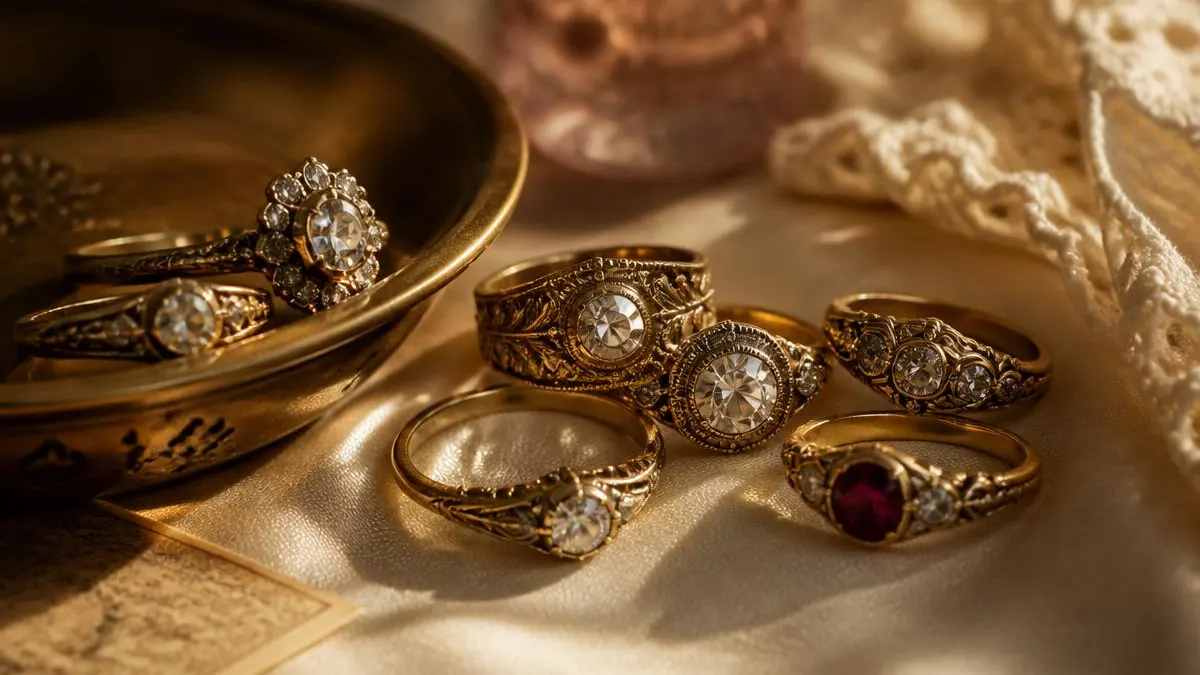
A good vintage ring stack works on profile before it works on style. Put the tallest or most sculptural ring where nothing rubs against it, use flat or low bands as spacers, keep one piece clearly dominant, and repeat something across the stack, a metal color, a stone or a texture, so it reads as deliberate. Protect antique settings by separating claw-set rings with a plain band and by keeping fragile pieces off the finger you use most.
Stacking is how most people wear vintage rings now, and it is also how most people damage them. Both facts come from the same place: rings that were made to be worn alone are suddenly rubbing against each other all day.
Here is how to build a stack that looks right and survives.
Shop the pieces: Signet, curated and available now.
Start with profile, not style
Lay your rings out and look at them side on. Anything with a raised head, a tall collet or an exposed claw needs a neighbor that will not attack it, which usually means a flat or slightly domed plain band.
A single tall ring flanked by two low bands reads as intentional. Two tall rings next to each other fight, both visually and physically.
Give the stack one lead
Choose one ring to be the point of the stack: the signet, the cluster, the toi et moi. Everything else supports it. Two competing lead rings is the most common reason a stack looks busy.
Odd numbers help. Three rings across two fingers usually looks more relaxed than four across two.
Mixing metals and eras
Mixing yellow, rose and white is not only allowed, it is how antique jewelry was often made in the first place, with platinum heads on gold shanks. To keep it coherent, repeat each metal at least twice across the hand rather than using one of each.
Eras mix easily because scale, not date, is what the eye reads. A Georgian cluster, a 1970s band and a plain modern band will sit together happily if their heights work.
- Repeat a metal, a stone color or a texture at least twice
- Put the plain band between the two most fragile rings
- Keep the tallest ring on the outside edge of the stack
- Leave one finger empty; a full hand loses the stack
Protecting antique rings in a stack
Metal wears metal. A soft 22K band next to a hard platinum ring will lose the argument, and worn claws are the leading cause of lost antique stones. Check claws and shanks once a year, and separate anything with millegrain or hand engraving from anything abrasive.
If you love a fragile ring, wear it on the hand you use less. It is unglamorous advice and it saves pieces.
Frequently asked questions
- Can you stack rings on the same finger as an engagement ring?
- Yes, and it is very common. Use a flat band next to the setting so nothing rubs the claws, and have the setting checked once a year if you wear the stack daily.
- Is it wrong to mix gold colors?
- No. Mixing looks best when each color appears more than once across the hand so it reads as a choice rather than an accident.
Written by our estate jewelry team and reviewed by our in-house gemologist, a GIA Graduate Gemologist (GG). We have been buying and selling European antique jewelry since 1973.
From the reading to the piece
Shop signet rings
Each piece is one of a kind and sells once, so this collection changes constantly.
View signetRelated guides
Keep reading
types
Types of vintage rings explained
Signet, solitaire, cluster, cocktail, eternity, toi et moi and halo, and how to tell them apart on the hand.
styling
Mixing gold tones
Yellow, rose and white together, the way antique jewelers already did it.
authenticity
Everyday wear and what actually damages jewelry
Chlorine, the gym and a good night's sleep cause more damage than clumsy hands ever do.
how-to
Resizing vintage rings, what is and is not possible
Some antique rings resize like any modern ring. Others should not be cut at all.