Authenticity & care
Reading maker's marks and hallmarks
How a mark set is built, what each stamp actually proves, and what it never can.
Written by our in-house jewelry team · Updated August 7, 2026 · 9 min read
In short
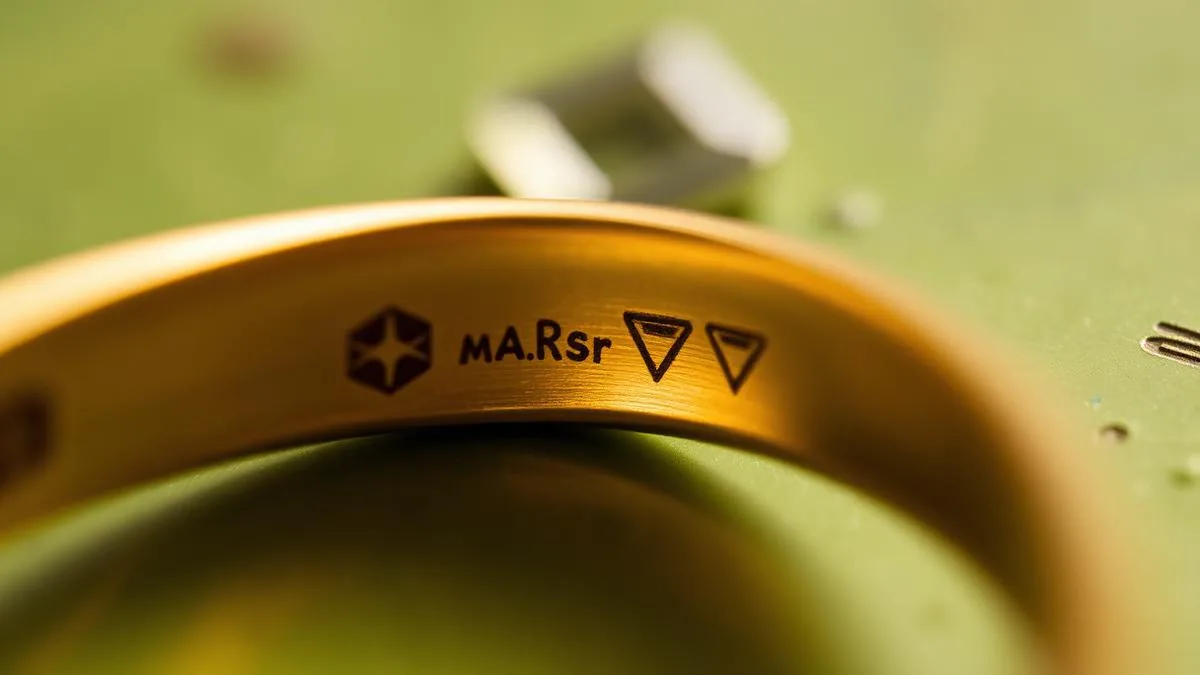
A hallmark is a small stamped record, usually a cluster of two to four marks struck close together, that can identify who made or sold a piece, the metal standard it was tested to, sometimes the country or office where it was tested, and sometimes the exact year. Reading a mark set means separating these elements and checking each one against reference tables for the country involved, because no single mark answers every question and a worn or partial set can leave real gaps.
Every one of our country guides, on French, British, Dutch, Cartier and Tiffany marks, assumes the reader already knows how a mark set is put together. This is that groundwork.
Marks are small, often worn, and easy to misread under poor light. Learning to separate what each stamp is actually claiming, rather than reading a mark set as one undifferentiated blur, is most of the skill.
Shop the pieces: Fine & rare, curated and available now.
The four things a mark set can tell you
A complete European mark set is built from up to four separate stamps, each doing a different job. The sponsor's mark identifies the maker or the retailer who submitted the piece for testing, usually as initials in a distinctive shield or lozenge. The standard mark states the metal fineness, either as a number such as 750 for 18K gold or as a symbol specific to the country, such as a head or an animal in French marking.
The assay office or town mark, where a country uses one, records where the piece was tested, which matters for tracing regional workshops. The date letter, used most consistently in British hallmarking, is a single letter in a particular typeface and shield shape that ties to one specific year, cycling through the alphabet in a documented sequence.
Not every country used all four elements, and not every era required them. American jewelry of the same period, for example, was rarely required to carry an assay office mark or a date letter at all, which is why American pieces often carry only a sponsor's mark and a karat stamp.
Worn and partial marks
Marks were struck into metal that has since been worn by decades of handling, resized, repolished, or simply struck lightly to begin with, and it is entirely normal to find a mark set where only two of the four elements are still legible. A worn standard mark that shows only the outline of a shield, with no readable digits, tells you less than a sharp one, but it does not make the piece suspect on its own.
The practical approach is to record what is legible, note what is missing, and avoid guessing at a letter or number that is not actually readable. A date letter read with real uncertainty is worse than no date letter at all, because it can anchor a wrong year in a listing or a memory.
Raking light, held to one side rather than straight on, is the single most useful tool for reading a worn mark, because it throws the remaining depth of the stamp into shadow and makes it legible again under magnification.
“Marks are evidence, not proof. We weigh them against the construction every time.”
Import marks
Jewelry made in one country and later sold in another sometimes carries a second mark set applied by the importing country's assay office, in addition to the original marks from the country of manufacture. British import marks are the clearest example: pieces made abroad and assayed in Britain from the late nineteenth century carry a distinct import mark alongside, not instead of, the foreign marks already present.
An import mark set is not a sign of anything wrong. It simply means the piece traveled through an assay system a second time, and it can be useful evidence for tracing where a piece was sold rather than only where it was made.
Marks added after the fact
Some marks on a piece were not struck at the time of manufacture. A retailer's stamp added when a piece changed hands, a case-back engraving added by a later jeweler, or a control mark applied when metal content was retested years afterward can all sit alongside the original marks and confuse a straightforward reading.
The tell is usually consistency of wear and finish. A later-added stamp tends to sit crisper, or in a different typeface, or cut at a slightly different depth than marks struck at the time the piece was made. Where a mark looks inconsistent with the rest of the set, it is worth treating it as a separate question rather than folding it into the same story.
What marks cannot prove
A mark confirms who submitted a piece and what the metal tested at, and in countries with date letters it can confirm the year of testing. It does not confirm that every stone currently in the piece is original, that the piece has not been resized or repaired since, or that a design correctly attributed to one era was not reworked later.
Marks and stylistic or construction evidence answer different questions, and the strongest attribution comes from checking that they agree rather than relying on either alone. Our gemologists read the mark set as one part of a wider examination, alongside cut, construction and wear, before writing an attribution into a listing.
- A mark proves testing and, sometimes, a maker and a year.
- A mark does not prove every stone is original to the piece.
- A mark does not prove a piece has never been altered or resized.
- Agreement between marks, cut and construction is stronger evidence than any one alone.
Frequently asked questions
- Where should I look for marks on a ring or a brooch?
- Inside a ring shank, on the edge of a bezel or gallery, under a brooch's pin catch or hinge, on a clasp tongue, and on the reverse of a pendant bail are the most common places. A loupe or a phone macro lens with light from the side works better than direct overhead light.
- Why do some antique pieces have no marks at all?
- Hallmarking requirements varied by country and era, and many jurisdictions, including much of the United States historically, never required a full mark set. Small workshops in any country also sometimes worked below the weight or value thresholds that triggered mandatory testing. Unmarked does not mean unimportant.
- Can a mark be faked?
- Yes, and the sponsor's marks of well known houses are the marks most often imitated, which is why a signature has to be checked against construction and period style rather than taken alone as proof.
- Does a country mark tell me exactly where a piece was made?
- It tells you where the piece was tested or, for some marks, where it entered a country's market, which is usually but not always the same place it was manufactured.
Written by our estate jewelry team and reviewed by our in-house gemologist, a GIA Graduate Gemologist (GG). We have been buying and selling European antique jewelry since 1973.
From the reading to the piece
Shop signed and fine pieces
Related guides
Keep reading
authenticity
How to read French gold and silver hallmarks
The eagle's head, the boar, the owl, and what French hallmarks can and cannot tell you.
authenticity
How to read British gold and silver hallmarks
Assay office marks, the date letter, and how the UK's hallmark system works.
authenticity
How Cartier marks its jewelry, and how we verify it
Signatures, serial numbers and why marks alone never settle authenticity.