Authenticity & care
How to read British gold and silver hallmarks
Assay office marks, the date letter, and how the UK's hallmark system works.
Written by our in-house jewelry team · Updated August 7, 2026 · 8 min read
In short
British hallmarks are among the most informative in the world because UK law has required four separate marks since the eighteenth century: a maker's mark, a fineness mark for the metal standard, an assay office mark showing which city tested the piece, and a date letter that changes on a set cycle. Read together and in good condition, they can pin a piece to a specific assay year, but a worn or partial mark set narrows the story considerably.
The United Kingdom has run compulsory hallmarking through its assay offices since 1300 in one form or another, making it the oldest continuous consumer protection system of its kind. For jewelry buyers today, the practical result is that a genuine, well-struck British hallmark can be more precise about dating than almost any other national system.
That precision is a gift and a trap in equal measure. It is a gift when the marks are clear, because they let us date a piece with real confidence. It is a trap if a buyer assumes every hallmark is that legible, or assumes a hallmark proves more about a piece's design and maker than it actually does.
Shop the pieces: Victorian, curated and available now.
The four traditional marks
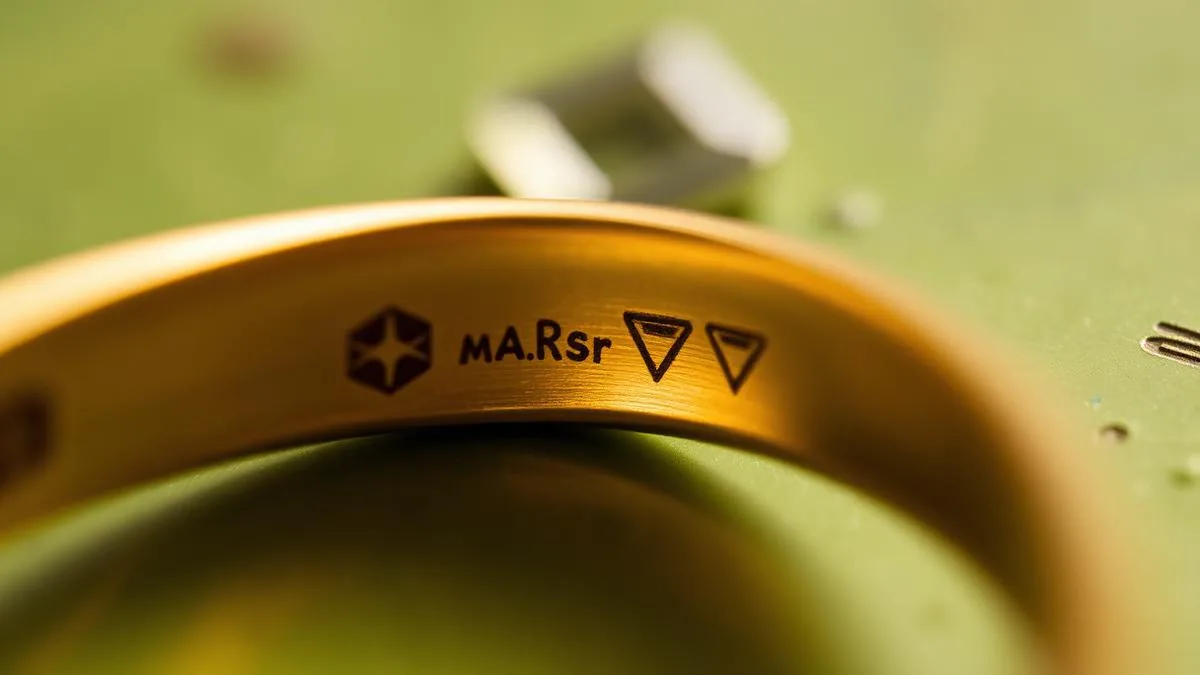
A full British hallmark historically carries a maker's or sponsor's mark, usually initials in a shaped surround registered by the individual or firm; a fineness mark showing the metal standard, such as 375, 585 (formerly 9K and 14K, expressed as karats before decimalization of the marking system), 750 for 18K gold, or a lion passant for sterling silver; an assay office mark specific to the city where the piece was tested, such as a leopard's head for London, an anchor for Birmingham, or a rose for Sheffield; and a date letter, a single letter in a specific typeface and shield shape that changes annually on a cycle run by each assay office.
Platinum carries its own fineness mark, an orb, introduced once platinum hallmarking became compulsory in the UK in the twentieth century. Older platinum jewelry made before that point may not carry a UK platinum mark at all, which is expected rather than a fault.
- Maker's or sponsor's mark: registered initials of the person or firm responsible
- Fineness mark: the metal standard, for example a lion passant for sterling silver or a numeric mark for gold karat
- Assay office mark: the city that tested the piece, for example London, Birmingham, Sheffield or Edinburgh
- Date letter: a single letter cycling on a set schedule, unique to each assay office's own sequence
Reading the marks in order
A practical order is to find the fineness mark first to confirm the metal, then the assay office mark to know which city's cycle applies, then the date letter, and finally the maker's mark. The date letter only means something once you know which assay office struck it, because London, Birmingham, Sheffield and Edinburgh have each run their own letter cycles with different typefaces and shield shapes over the years, and a given letter shape corresponds to a specific office and period rather than to a universal calendar.
Because that cross-referencing takes real specialist reference material to do accurately, we do not print a public year-by-year date letter chart in this guide. Reputable published assay office tables exist and dating specialists use them carefully, matching typeface, shield shape and office together rather than reading a single letter in isolation.
Common pitfalls
Worn hallmarks are common on rings, since the inside of a shank sees a lifetime of contact with a finger, cleaning cloths, and other jewelry. A shallow or partial strike does not mean the piece is not genuinely marked, only that the full mark set may not be fully legible today.
Resized rings are a particular case worth understanding. When a ring shank is cut and resized, the original hallmark, which is normally struck on the shank, can be removed, split across the join, or in some cases restruck. A missing or oddly placed hallmark on an otherwise clearly antique ring often reflects a later resizing rather than a modern fake, and we note this in listings when it is visible.
Import marks are another source of confusion. Foreign-made items sold into the UK market at various points carried their own import hallmark set, which can look unfamiliar next to standard British marks but is a legitimate part of UK hallmarking history rather than a warning sign.
- A worn or shallow strike is common on ring shanks and does not by itself suggest a fake
- A resized ring can lose, split, or restrike its original hallmark
- Import hallmarks are a legitimate category, not evidence of a problem
What British hallmarks cannot tell you
Hallmarks confirm the metal standard and, when the full set is legible, the assay office and testing year, plus a registered maker's mark. They do not confirm who designed a piece beyond the sponsor named, they do not confirm that every stone in the piece is original to the mount, and they do not on their own prove authenticity for a piece attributed to a famous retailer beyond what the registered mark shows. Our gemologist reviews construction and stones separately from the hallmark reading for exactly this reason.
Frequently asked questions
- What is a date letter on a British hallmark?
- A single letter, in a specific typeface and shield shape, that each UK assay office changes on its own cycle. It can date a piece precisely when matched correctly to the right office and reference table.
- Why does my antique ring only show part of a hallmark?
- Wear from decades of contact, or a past resizing that cut and rejoined the shank, are the two most common reasons a ring shows a partial or missing hallmark.
- What does a lion passant mean on silver?
- It is the traditional English fineness mark confirming sterling silver, 925 thousandths fine.
- Does every British assay office use the same date letters?
- No. London, Birmingham, Sheffield and Edinburgh have each run their own letter cycles, with different typefaces and shield shapes, so a letter must be read together with its office mark.
- Can a hallmark alone prove a piece was made by a specific well-known jeweler?
- Only to the extent that the registered sponsor's mark identifies that maker or retailer. It does not independently confirm design attribution or that every stone is original to the piece.
Written by our estate jewelry team and reviewed by our in-house gemologist, a GIA Graduate Gemologist (GG). We have been buying and selling European antique jewelry since 1973.
From the reading to the piece
Shop Victorian jewelry
Each piece is one of a kind and sells once, so this collection changes constantly.
View victorianRelated guides
Keep reading
authenticity
How to read French gold and silver hallmarks
The eagle's head, the boar, the owl, and what French hallmarks can and cannot tell you.
authenticity
How to read Dutch gold and silver hallmarks
The zoetermeer, the lion, and how the Netherlands marks precious metal.
authenticity
How to tell if vintage jewelry is real
Genuine period jewelry usually agrees with itself. Reproductions rarely do.