Buying & value
Understanding condition grades in vintage jewelry
What wear is normal for a hundred year old piece, and what actually reduces value.
Written by our in-house jewelry team · Updated August 7, 2026 · 8 min read
In short
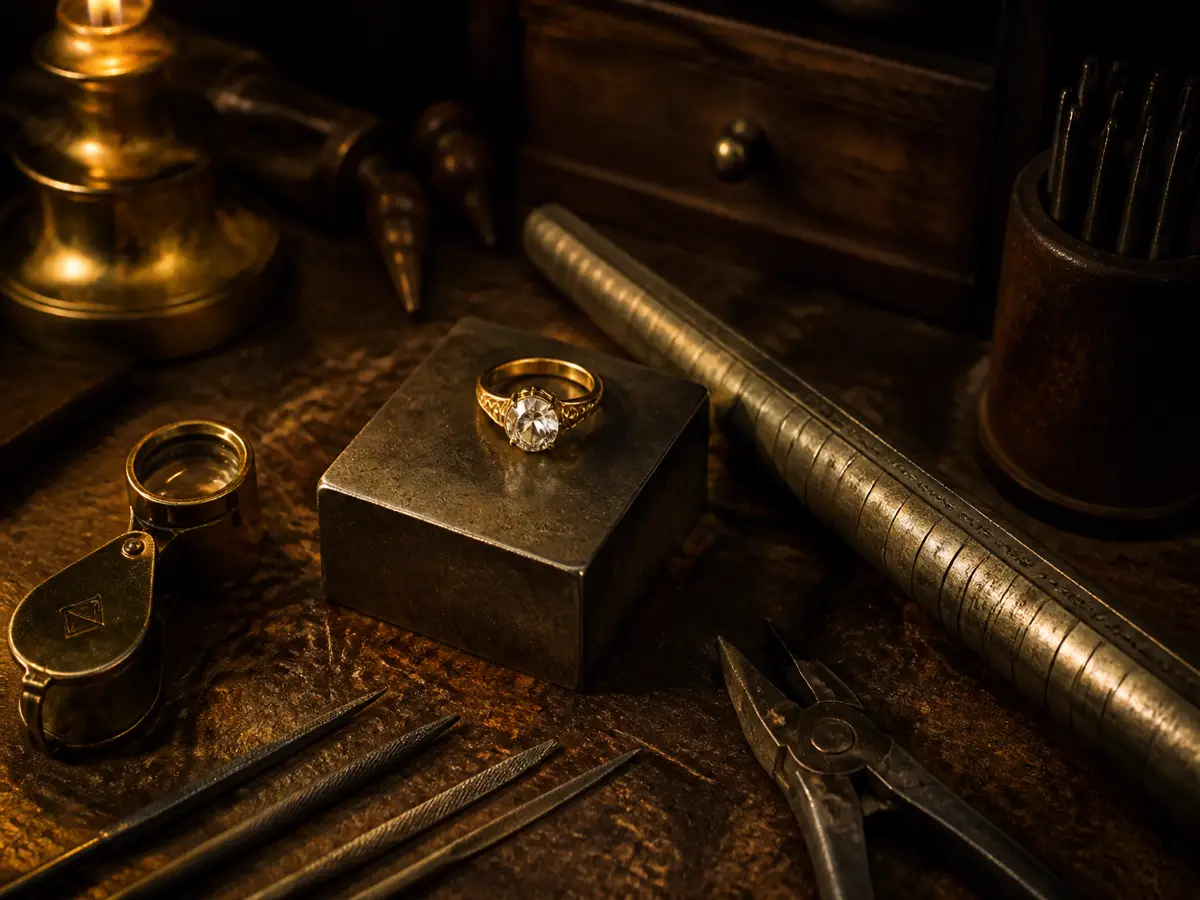
Condition in antique jewelry is judged relative to age rather than against a brand-new standard. Light surface wear, gentle softening of engraving, and an honestly disclosed old repair are normal and expected in a piece that has been worn for decades or a century, and they do not significantly reduce value. What does affect condition and value is structural weakness such as a badly thinned shank, undisclosed replacement stones, mismatched repairs, or heavy-handed re-polishing that has removed original detail.
New jewelry is graded against perfection. Antique jewelry cannot be, because almost none of it has survived untouched, and a piece that looks factory-fresh after a century is more likely to have been over-restored than genuinely pristine.
This is how we think about and describe condition, and it is worth understanding before you read any of our own listings, so that a phrase like 'shows light wear consistent with age' reads as the reassurance it is meant to be rather than a warning.
Shop the pieces: New arrivals, curated and available now.
What we mean by wear
Wear is the gradual, gentle rounding and softening that comes from decades of being worn, handled and occasionally knocked. On a ring it shows as a slight thinning at the base of the shank and softened edges on the highest points of any engraving or texture. On a brooch it shows at the pin catch and the back plate.
This kind of wear is not a defect. It is evidence that a piece is genuinely old and has been used for the purpose it was made for. We describe it plainly, and we treat it as entirely separate from damage.
Repairs, and why they are normal
A piece that has survived 50, 100 or 150 years has almost certainly needed a repair at some point: a re-tipped claw, a replaced pin stem, a resoldered join, a strengthened hinge. Skilled, sympathetic repair work that matches the original construction is a sign the piece has been cared for, not a mark against it.
What matters is disclosure and quality. A repair should be mentioned plainly in a description, and it should be done in a way that respects the original materials and technique, rather than replacing hand-finished work with a rough modern equivalent.
Replaced stones
Stones are sometimes replaced over a piece's lifetime, whether because an original stone was damaged or lost, or because an owner chose to upgrade it. A replacement is not automatically a problem, but it should be disclosed, and a well-matched replacement in period-appropriate cut and color affects value far less than a mismatched one.
A common warning sign is a stone whose cut clearly postdates its mount, such as a modern round brilliant sitting in claws shaped for an old European cut. This tells you a swap has happened, even if no one along the way mentioned it.
Re-shanking and structural work
Re-shanking, where all or part of a ring's shank is rebuilt, is a legitimate and often necessary repair on rings that have been worn thin over many decades. It is more significant than a claw re-tip because it replaces more of the original metal, so we always state clearly when a ring has been re-shanked, in full or in part.
A shank that has worn to under roughly a millimeter at its thinnest point is at real risk of failure and should either be disclosed as needing this work soon, or already re-shanked and disclosed as such.
What is acceptable in a hundred year old piece
In general, we consider the following normal and acceptable for genuinely antique jewelry: light overall surface wear, a softened but still legible hallmark, one or two sympathetically executed old repairs, minor case or setting wear on the reverse, and small variations from perfect symmetry that reflect hand construction.
We consider the following more significant and always worth disclosing clearly: heavy re-polishing that has visibly altered original detail, multiple mismatched repairs, replaced stones of the wrong cut or color, enamel loss, and any structural weakness that would affect how safely the piece can be worn.
Frequently asked questions
- Does light wear reduce the value of an antique piece?
- Not significantly. Light wear consistent with genuine age is expected and is treated as normal, not as damage, when we assess a piece.
- Is a repaired antique ring less desirable than an unrepaired one?
- Not necessarily. A sympathetically repaired ring that has been properly cared for is often more stable to wear than one that has never been touched but is quietly weakening. What matters is that repairs are disclosed and well executed.
- How do I know if a ring needs re-shanking?
- A goldsmith or gemologist can measure the shank thickness. As a rough guide, a shank worn to under about a millimeter at its thinnest point is approaching the point where it needs rebuilding.
- Should an antique piece look brand new?
- Generally no. A piece that looks completely untouched after a century has usually been heavily re-polished, which can soften original detail and, in some cases, reduce value rather than protect it.
Written by our estate jewelry team and reviewed by our in-house gemologist, a GIA Graduate Gemologist (GG). We have been buying and selling European antique jewelry since 1973.
From the reading to the piece
Shop new arrivals
Each piece is one of a kind and sells once, so this collection changes constantly.
View new arrivalsRelated guides
Keep reading
buying
What makes vintage jewelry valuable
Rarity, maker, craftsmanship and condition matter more than age on its own.
buying
How we price our pieces
Materials, maker, era, rarity, condition, provenance and the market together, weighed honestly.
authenticity
How to tell if vintage jewelry is real
Genuine period jewelry usually agrees with itself. Reproductions rarely do.