Eras
Art Nouveau jewelry guide, 1890 to 1910
Enamel, whiplash curves and the human figure in gold, made to be looked at rather than appraised by carat.
Written by our in-house jewelry team · Updated August 7, 2026 · 8 min read
In short
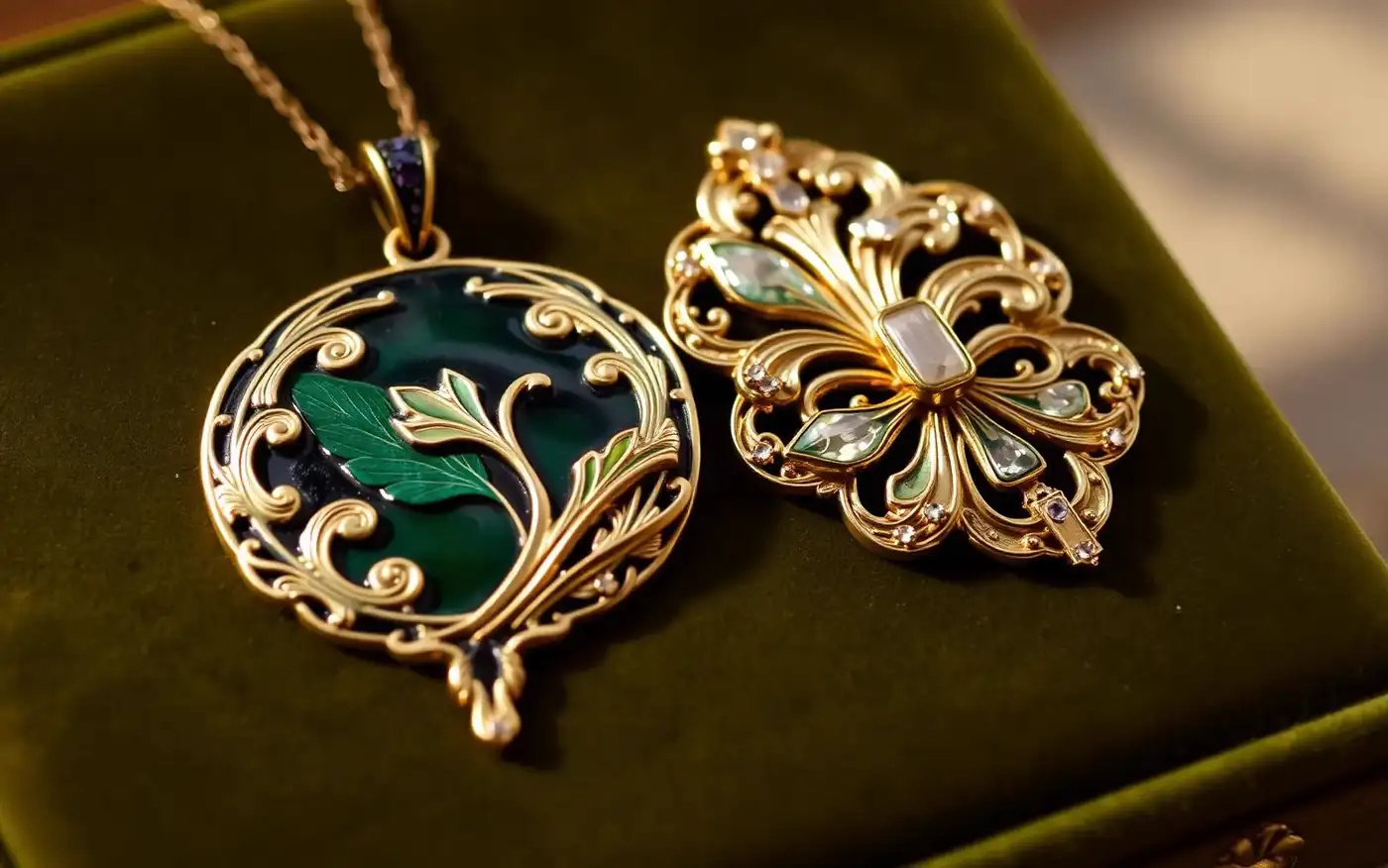
Art Nouveau jewelry, made roughly between 1890 and 1910, prized artistry and mood over carat weight, using low-karat gold, glass, horn and especially plique-a-jour enamel alongside gemstones. Look for asymmetric whiplash curves, dragonflies, orchids, peacocks and the flowing-haired female form. The style was brief and largely handmade, which is why genuine pieces are now scarce and why later Art Nouveau revival jewelry, made from the mid twentieth century onward, needs to be identified as exactly what it is.
Art Nouveau was a short, intense reaction against machine-made, gem-heavy Victorian jewelry. Its leading makers, above all Rene Lalique in Paris, treated a brooch as a small sculpture rather than a display of carats, and chose materials for color and effect rather than resale value.
That approach is exactly why so little of it survives compared with other eras. Enamel is fragile, low-karat gold and horn were never melted for their metal value the way high-karat pieces were, and total output was small to begin with.
The movement was international, with parallel schools in France, Belgium, Germany, Austria and the United States, but its core visual language, curving organic line and a dreamlike treatment of nature and the female form, stayed remarkably consistent across all of them.
Shop the pieces: Art Nouveau, curated and available now.
How the era is dated
Art Nouveau jewelry is generally dated from around 1890, when the style first appeared fully formed in Paris and Nancy, to around 1910, by which point it had largely given way to the more restrained, precious-stone-focused Edwardian and early Art Deco taste. Some scholars place its true peak as narrowly as 1895 to 1905.
Because the style was driven by a relatively small number of designers and workshops working over a short span, pieces are usually dated by close stylistic and technical analysis rather than by hallmark alone, though French pieces do often carry maker's marks that help narrow attribution.
Materials, metals and enamel
Art Nouveau jewelers deliberately used materials that had been considered secondary in earlier Victorian jewelry. Low-karat gold, silver, horn, ivory, glass and enamel appear on equal footing with gemstones, chosen for color and texture rather than intrinsic value.
Plique-a-jour enamel, a technique that produces panels of translucent color with no metal backing, so that light passes through the enamel the way it would through stained glass, is the technical showpiece of the period. It is extremely difficult to execute and extremely fragile, and it remains one of the clearest and most desirable signatures of genuine Art Nouveau work.
“Art Nouveau sold artistry rather than metal weight, and that is still the fairest way to price it.”
Construction and technique
Pieces were largely handmade by skilled workshops rather than produced in volume, with sculptural, three-dimensional modeling that treats a brooch or pendant as a miniature figure rather than a flat setting for stones. Casting, chasing and hand enameling all played a part, often within the same piece.
Because the emphasis was on form and color rather than carat weight, gemstones are frequently smaller, irregularly shaped or used as accents rather than centerpieces, a marked contrast to the diamond-forward Edwardian jewelry made at almost the same time.
Motifs and typical stones
Subjects come from nature and from a particular, dreamlike idea of the female form: flowing hair, wings, insects and flowers rendered with real anatomical attention. Dragonflies, orchids, irises, peacocks, swans and female figures with streaming hair recur across French, Belgian and American work alike, usually arranged in the flowing, asymmetric whiplash line that gives the style its name.
Opals, moonstones, freshwater pearls, amethyst and demantoid garnet appear more often than diamonds, prized for their color and their play of light rather than for size or clarity.
- Plique-a-jour enamel with light passing through from behind
- Asymmetric, flowing whiplash lines rather than symmetrical repetition
- Dragonflies, orchids, peacocks and the flowing-haired female figure
- Low-karat gold, horn, ivory and glass used alongside gemstones
- Opal, moonstone and demantoid garnet favored over diamond for color
Telling genuine pieces from later revivals
Art Nouveau's popularity has been revived more than once, notably from the 1960s onward, and revival pieces made in the style are common in the market today, sold honestly as later homages or, less honestly, passed off as period. The clearest tell is enamel quality and technique: genuine plique-a-jour from the period was made by specialist enamelists at enormous skill, and a piece with painted or backed enamel imitating the translucent look, rather than true open-backed plique-a-jour, is not from the period.
Casting seams, modern findings such as post earring backs or sprung clasps, and stones cut with modern precision are all signs of later manufacture. We examine construction under magnification and identify enamel technique before describing any piece as genuine Art Nouveau.
Condition and wearability
Enamel, and plique-a-jour above all, is the most vulnerable material in any antique jewelry box. It can crack from a knock, from sudden temperature change, or simply from a century of handling, and once cracked it is a delicate and specialist repair rather than a simple fix.
Because of this, we generally recommend that genuine Art Nouveau enamel pieces be worn with real care, kept away from ultrasonic cleaners and harsh chemicals, and stored separately so they cannot knock against harder jewelry.
Buying notes for US buyers
Because genuine period Art Nouveau is scarce and revival pieces are common, ask directly whether a piece is being sold as period or as a later homage, and expect close-up photography of the enamel and any maker's mark before you buy.
Every Art Nouveau piece we sell is examined and dated in-house by our gemologist, a GIA Graduate Gemologist (GG), before listing, with a detailed valuation and authenticity report prepared by our gemologist, a GIA Graduate Gemologist (GG), available on request. As with everything we sell, US orders ship free and insured with duties included, and returns are free, insured, and open for 30 days.
Frequently asked questions
- What years count as Art Nouveau jewelry?
- Roughly 1890 to 1910, with the style's peak generally placed between about 1895 and 1905.
- What is plique-a-jour enamel?
- An enameling technique with no metal backing, so light passes through the colored enamel from behind, similar in effect to stained glass. It is one of the clearest signatures of genuine Art Nouveau work.
- Why does Art Nouveau jewelry rarely use large diamonds?
- The style valued artistic form, color and mood over carat weight, so designers reached for opal, moonstone, enamel and smaller accent stones rather than large diamonds.
- How can I tell genuine Art Nouveau from a later revival piece?
- Look closely at the enamel technique, the metal finish and the findings. Later revival and reproduction pieces tend to use backed or painted enamel rather than true plique-a-jour, along with modern castings and clasps.
- Is Art Nouveau jewelry fragile?
- Enamel work, especially plique-a-jour, is genuinely delicate and should be worn and stored with care, though the gold and gemstone elements of a piece are typically as durable as any antique jewelry.
- Is Rene Lalique the only maker to look for?
- No. Lalique is the movement's best-known name, but France, Belgium, Germany, Austria and the United States all produced fine Art Nouveau jewelry through their own designers and workshops.
Written by our estate jewelry team and reviewed by our in-house gemologist, a GIA Graduate Gemologist (GG). We have been buying and selling European antique jewelry since 1973.
From the reading to the piece
Shop Art Nouveau jewelry
Each piece is one of a kind and sells once, so this collection changes constantly.
View art nouveauRelated guides
Keep reading
eras
Victorian jewelry: a complete guide
1837 to 1901, sixty-four years of jewelry that was made to be worn every day and usually shows it.
eras
Edwardian jewelry guide, 1901 to 1915
Platinum lace, millegrain and diamonds that appear to float on almost no visible metal.
glossary
The visual language of vintage jewelry
Snakes, hands, crescents and forget-me-nots: what antique motifs were meant to say, and who wore them.