Gemstones & cuts
Moonstone and the trick of adularescence
The feldspar that seems to hold its own light, and defined Art Nouveau jewelry.
Written by our in-house jewelry team · Updated August 7, 2026 · 6 min read
In short
Moonstone is a variety of feldspar, at about 6 to 6.5 on the Mohs scale, valued for adularescence, the soft billowing glow of light that seems to float just beneath the surface of the stone. It is untreated in almost every case, since the effect is structural rather than added, but it is comparatively soft and can have internal stress fractures, so it needs gentler handling than harder stones. It is closely associated with Art Nouveau and Arts and Crafts jewelry, where its quiet, otherworldly light suited the naturalistic themes of the period.
Moonstone is one of the few gems valued for an optical effect rather than color or clarity in the usual sense, and that effect is unusually difficult to describe until you have watched it move across a stone in person.
It is also a genuinely soft stone by gem standards, which shapes both how it should be worn and why so much surviving antique moonstone shows some wear.
Shop the pieces: Art Nouveau, curated and available now.
What moonstone is
Moonstone is a variety of orthoclase or, less commonly, albite feldspar, formed from microscopic alternating layers of two feldspar types within the crystal. Light entering the stone scatters off these layers and produces adularescence, the glow that seems to hover under the surface and move as the stone is tilted.
At roughly 6 to 6.5 on the Mohs scale it sits well below quartz and considerably below sapphire, and feldspar also has cleavage planes, meaning a sharp knock can crack the stone along a preferred direction rather than simply scratching the surface.
Color range and what drives it
Classic moonstone has a colorless to milky white body with a blue adularescent glow, the most prized combination in the trade. Body color can also run to grey, peach, champagne or a pale green, and the strength and color of the glow, rather than the body color alone, is what separates a fine stone from an ordinary one.
The blue sheen is strongest when the stone is cut as a smooth, high-domed cabochon oriented correctly relative to the internal layering, which is a cutter's skill rather than a treatment.
Clarity, inclusions and treatments
Moonstone often contains fine internal stress fractures, sometimes called centipedes for their branching appearance, which are typical of the material and not usually treated as a serious flaw unless they reach the surface.
Moonstone is essentially untreated. Its defining quality is structural rather than color-based, so there is no equivalent of heat treatment or irradiation applied to it in normal trade practice, and any dyeing to alter body color should be disclosed if suspected.
Durability and care
Because it is relatively soft and has cleavage, moonstone is better suited to earrings, pendants and occasional-wear rings than to a ring worn daily doing housework or manual tasks. Internal stress fractures can also grow over time with rough handling.
We advise against ultrasonic and steam cleaning for moonstone. A soft cloth or a gentle rinse in lukewarm water is enough, and moonstone jewelry is best stored separately from harder stones that could scratch its relatively soft surface.
Moonstone through the eras
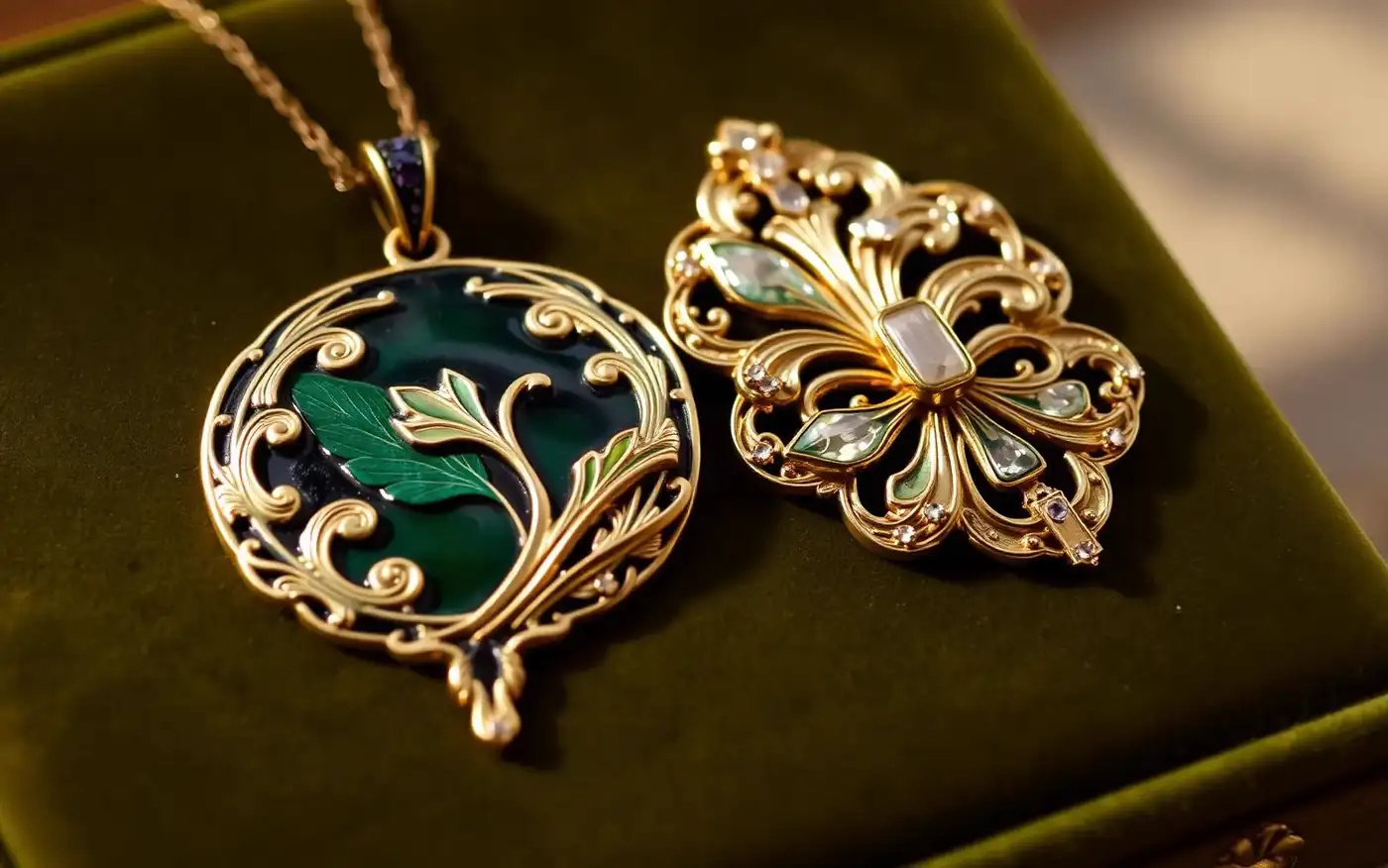
Moonstone is most strongly associated with Art Nouveau, from roughly the 1890s to around 1910, when its soft, mysterious glow suited the movement's fascination with nature, moonlight and the female form, often set in silver-topped gold or platinum alongside enamel and pearls.
It also appears in Arts and Crafts jewelry of the same general period, usually in simpler hand-wrought silver settings, and saw further revivals in the 1960s and 70s as part of a broader interest in unusual, non-traditional stones.
Imitations and look-alikes
Synthetic spinel and various glass imitations have been sold as moonstone, along with a milky chalcedony sometimes marketed as a cheaper substitute. None of these show true adularescence, the specific rolling blue glow caused by feldspar's internal structure, though a good imitation can look convincing at a glance.
Rainbow moonstone, a trade name for a variety of labradorite feldspar with a similar sheen, is a related but distinct material and worth naming correctly, since true moonstone and rainbow moonstone are not identical in composition even though the visual effect is closely related.
Frequently asked questions
- What causes the glow in moonstone?
- Adularescence, an optical effect caused by light scattering off microscopic layers of two different feldspar types within the crystal. It is a structural property of the stone, not a coating or treatment.
- Is moonstone durable enough for a ring?
- It can be worn in a ring with a protective setting and occasional care, but at roughly 6 to 6.5 on the Mohs scale with cleavage present, it is better suited to earrings and pendants for daily-wear purposes.
- Is rainbow moonstone the same as moonstone?
- No. Rainbow moonstone is a trade name for a labradorite feldspar with a similar glow. True moonstone is orthoclase or albite feldspar. Both show adularescence, but they are different materials.
- Why does old moonstone sometimes look cloudy?
- Fine internal stress fractures are typical of the material and often present from formation. Surface wear from decades of contact can also soften the polish and slightly mute the glow.
Written by our estate jewelry team and reviewed by our in-house gemologist, a GIA Graduate Gemologist (GG). We have been buying and selling European antique jewelry since 1973.
From the reading to the piece
Shop Art Nouveau jewelry
Each piece is one of a kind and sells once, so this collection changes constantly.
View art nouveauRelated guides
Keep reading
gemstones
Gemstone treatments explained
Heat, oil, fracture filling, diffusion and dye: which are routine, which are serious, and how each is spotted.
eras
Art Nouveau jewelry guide, 1890 to 1910
Enamel, whiplash curves and the human figure in gold, made to be looked at rather than appraised by carat.
gemstones
Living with opal
Water, silica and the play of color that defined Art Nouveau.