Symbolism & meaning
Flower jewelry and the language of flowers
Forget-me-nots, pansies, ivy and lilies, and what a Victorian giver expected you to read into them.
Written by our in-house jewelry team · Updated August 7, 2026 · 6 min read
In short
Nineteenth century floral jewelry drew on the language of flowers, a widely published Victorian convention in which each bloom carried a sentiment. Forget-me-nots meant remembrance and true love, pansies meant thoughts, from the French pensée, ivy meant fidelity and lasting attachment, and lilies were associated with purity. These meanings were popular conventions rather than a fixed code, and they varied between publications and countries.
Victorian flower jewelry was rarely just decorative. Giving a forget-me-not brooch was saying something, and both people knew it.
Below are the motifs you will meet most often, their conventional meanings, and how floral design changes across the eras so you can date a piece by its flowers.
Shop the pieces: Art Nouveau, curated and available now.
The common motifs
These meanings come from the Victorian flower-language books that circulated widely in Britain, France and the Netherlands. Treat them as convention and sentiment, not as a strict code: the books themselves disagreed with each other.
- Forget-me-not: remembrance, true love. Often turquoise or blue enamel
- Pansy: thoughts, from the French pensée. Often enameled
- Ivy: fidelity, friendship, attachment that clings
- Rose: love, with the color and stage of the bloom shading the meaning
- Lily and lily of the valley: purity, returned happiness
- Wheat and grapes: abundance and plenty
- Fuchsia, wisteria and orchid: the Art Nouveau favorites, chosen for line as much as meaning
Dating a piece by its flowers
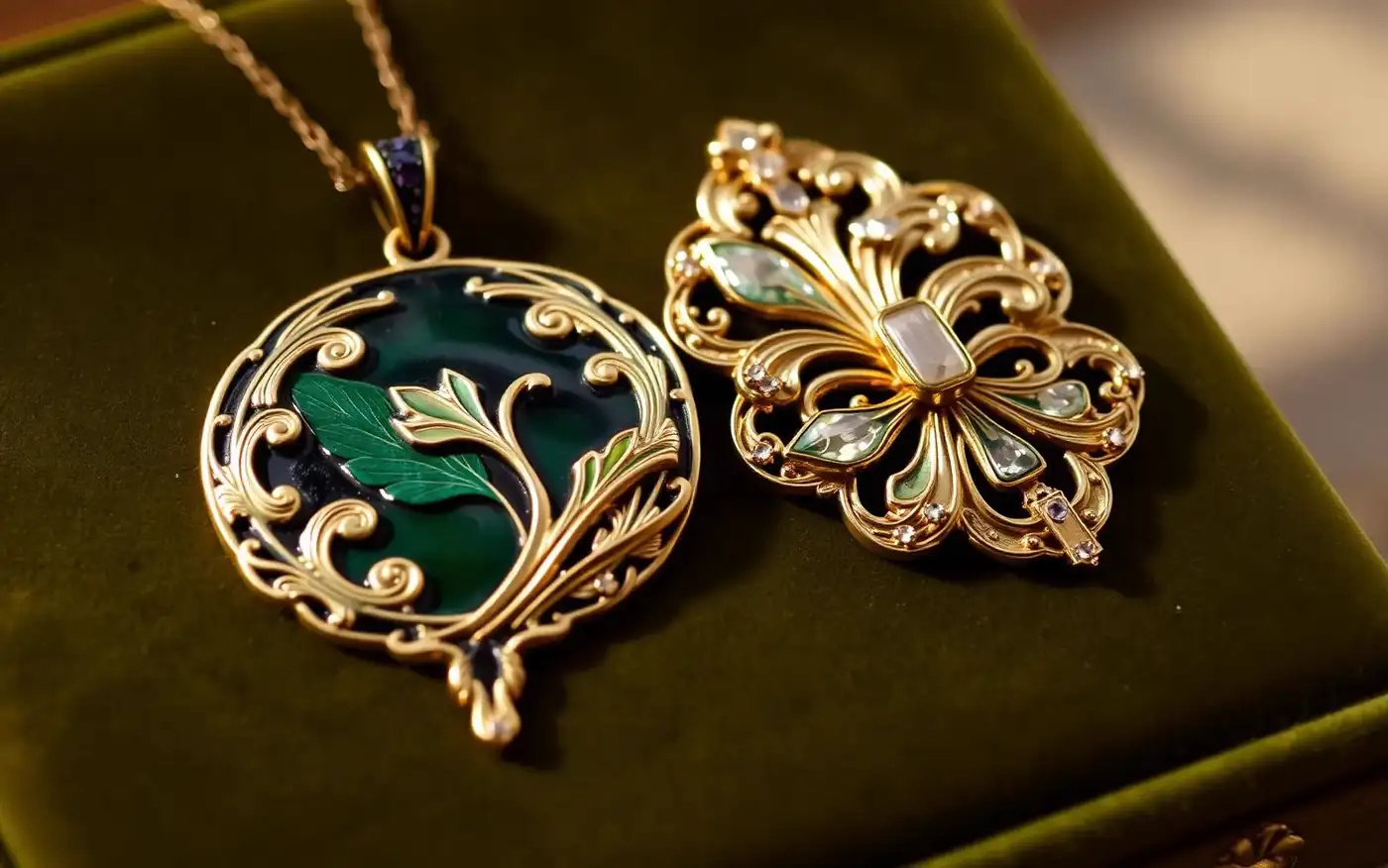
Georgian and early Victorian flowers are stylized and symmetrical, often gem-set in silver over gold. High Victorian flowers get naturalistic and three-dimensional, with tremblant springs that let a flower head shiver as the wearer moves.
Art Nouveau, from around 1890 to 1910, abandons the sweet bouquet for a whole plant in motion: sinuous stems, plique-à-jour enamel and unusual, sometimes wilting blooms. Mid-century floral spray brooches return to gold and are frankly decorative, with no coded meaning intended.
Enamel, turquoise and pearls
Floral jewelry leans on materials that need care. Turquoise is porous and can change color from contact with oils and cosmetics, seed pearls are strung on silk that perishes, and enamel chips.
None of this should put you off. It just means a floral piece belongs in the gentle-wear category, and it should never go near an ultrasonic cleaner.
Frequently asked questions
- What does a forget-me-not mean in jewelry?
- Remembrance and true love. It is one of the most consistent motifs in the Victorian language of flowers and appears on lockets, brooches and mourning pieces alike.
- Was the language of flowers a real code?
- It was a widely published popular convention rather than a fixed system. Different books gave different meanings, so we describe motifs as traditionally associated with a sentiment rather than as proof of intent.
Written by our estate jewelry team and reviewed by our in-house gemologist, a GIA Graduate Gemologist (GG). We have been buying and selling European antique jewelry since 1973.
From the reading to the piece
Shop Art Nouveau jewelry
Each piece is one of a kind and sells once, so this collection changes constantly.
View art nouveauRelated guides
Keep reading
eras
Art Nouveau jewelry guide, 1890 to 1910
Enamel, whiplash curves and the human figure in gold, made to be looked at rather than appraised by carat.
eras
Victorian jewelry: a complete guide
1837 to 1901, sixty-four years of jewelry that was made to be worn every day and usually shows it.
how-to
Caring for pearls, opals and other soft stones
Last on, first off, and never in an ultrasonic.
glossary
The visual language of vintage jewelry
Snakes, hands, crescents and forget-me-nots: what antique motifs were meant to say, and who wore them.