Symbolism & meaning
Heart jewelry: meaning and history
Witch's hearts, crowned hearts and double hearts, and what each one was given to say.
Written by our in-house jewelry team · Updated August 7, 2026 · 6 min read
In short
The heart is the oldest love token in European jewelry and it appears in several distinct forms. A plain heart stands for love and affection, a crowned heart for loyalty or love triumphant, a double or twin heart for two people joined, and a witch's heart, with its curved and twisted point, was worn as a charm to protect the wearer's affections. Heart lockets combine the motif with a compartment for hair or a photograph.
A heart is easy to dismiss as sentimental shorthand. In antique jewelry it is more specific than that: the shape of the heart, what sits on top of it and what is inside it all carry meaning.
This is the short version of a very long tradition, focused on the forms you will actually see for sale.
Shop the pieces: Locket, curated and available now.
The witch's heart
A witch's heart leans to one side, with its point curling away like a flame. The form appears from the seventeenth century onward and is strongly associated with Scotland. It was given as a love token and as a protective charm, the idea being that it guarded the wearer's affections.
Period examples are usually gem-set in silver over gold, often with a crown or a bow above. Because the type has been reproduced continuously, hallmarks and construction matter more here than in almost any other motif.
Crowned hearts and Luckenbooth brooches
A crown above a heart is a very old betrothal and loyalty symbol. In Scotland the Luckenbooth brooch, named after the locked booths near St Giles' in Edinburgh, is typically a crowned heart or two intertwined hearts, exchanged as a love token and later pinned to a child's shawl for protection.
The Irish claddagh, a heart held by two hands beneath a crown, belongs to the same family of ideas and is covered in our guide to hands in jewelry.
Victorian heart lockets and padlocks
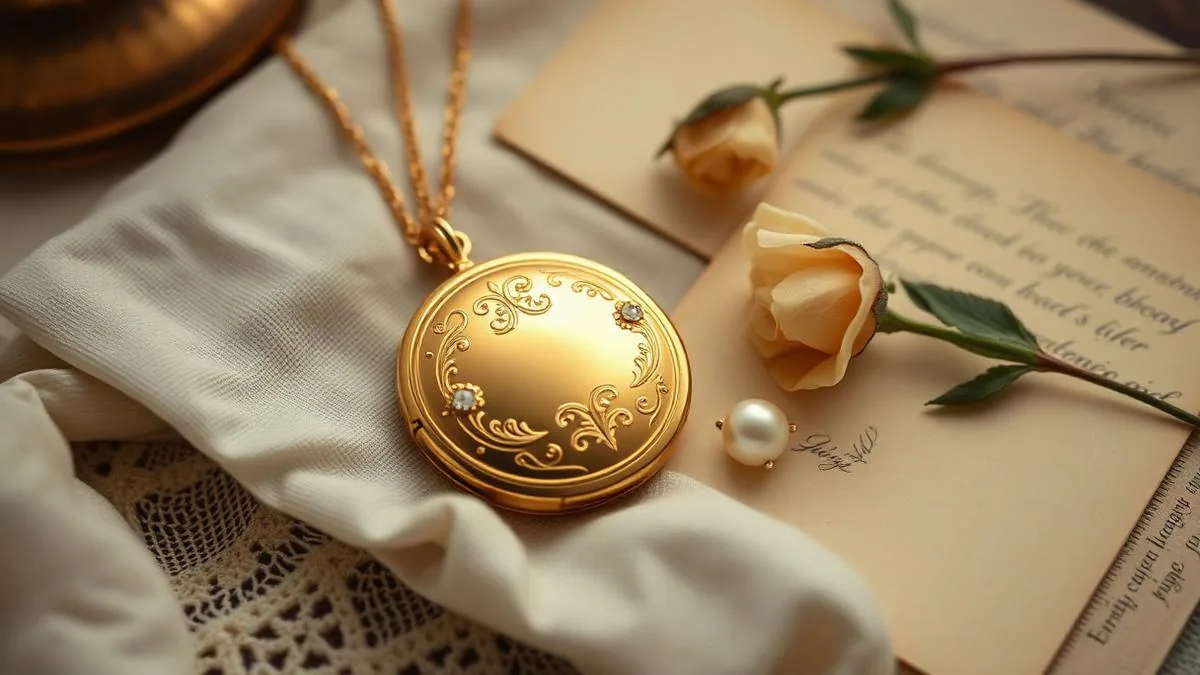
The Victorians industrialized the heart. Gold-front and silver heart lockets, engraved with ivy, forget-me-nots or a monogram, were made in enormous numbers and are still the most wearable antique pendants you can buy.
The heart padlock, usually on a gate or curb bracelet, locks the bracelet and the sentiment at once. Original keys almost never survive, and a padlock that no longer locks can normally be repaired.
Frequently asked questions
- What is a witch's heart?
- A heart with a curved, twisted point, made from roughly the seventeenth century onward and associated with Scotland. It was given as a love token and worn as a charm to protect the wearer's affections.
- Do antique heart lockets still open?
- Most do. Hinges and glazed compartments can be tired and are usually repairable. We say in each description whether a locket opens and closes as it should.
Written by our estate jewelry team and reviewed by our in-house gemologist, a GIA Graduate Gemologist (GG). We have been buying and selling European antique jewelry since 1973.
From the reading to the piece
Shop lockets
Each piece is one of a kind and sells once, so this collection changes constantly.
View locketRelated guides
Keep reading
symbolism
Lockets and keepsake jewelry
A jewel with an inside. What went into a Victorian locket, and what to check before you buy one.
symbolism
Hands in jewelry: fede, claddagh and mizpah
Two clasped hands, one of the oldest promises in European jewelry, and its Irish descendant.
symbolism
Acrostic and regard jewelry explained
Rings that spell a word in gemstones: REGARD, DEAREST, and the private ones nobody else could read.
eras
Victorian jewelry: a complete guide
1837 to 1901, sixty-four years of jewelry that was made to be worn every day and usually shows it.